
Blogs
Chocolate Landmarks Food Network Challenge Feb 10th at 8.00pm. Watch Fritz and Torben Bang compete amongst the best in the chocolate industry. The show also airs Feb 11th 3.00am, Feb 13th 9.00pm, Feb 14th 12.00am, Feb 16th 2.00am, Feb 17th 7.00pm.
Fritz's throwdown with Bobby Flay will also be aired on Food Network the same night at 10.30pm. The show also airs Feb 11th 1.30am, Feb 19th 9.30pm, Feb 20th 12.30am and Feb 23rd 4.30pm
Fritz's throwdown with Bobby Flay will also be aired on Food Network the same night at 10.30pm. The show also airs Feb 11th 1.30am, Feb 19th 9.30pm, Feb 20th 12.30am and Feb 23rd 4.30pm
Posted in: default
| 2 comments
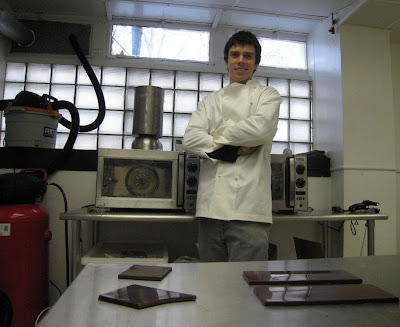
Rogue Chocolatier is the newest American bean to bar chocolate maker. Located in Minneapolis, Minnesota, this efficiency apartment sized chocolate factory was started just a few months ago by Colin Gasko. Aside from the fact that he has created what is most likely the world's smallest chocolate factory, there are a few things you should know about Colin. He is 22 years old, he doesnt own a car, he does a lot of the work himself, he has not yet been to a cacao plantation and he makes fantastic chocolate.
A bean to bar chocolate manufacturer means a maker who does everything from the raw bean, starting with cacao beans that have been fermentedand dried by the grower, but not yet roasted. So the beans are takenall the way from this raw state to a molded bar of chocolate by thesame maker. The process begins with sorting, then roasting, thenwinnowing and cracking, then grinding, then mixing, then conching. Andthen there is tempering, molding, cooling, and wrapping. Colin does nothave employees, and much of this is his one man show. He is helped outby his father four days a week, and a friend pitches in ten hours aweek. Colin often relies on friends for transportation.
Therearent many bean to bar makers in the world, some 50 or so at lastverified count. About 20 are in the United States. When I say verified,it is because bean to bar has become a desirable label denoting anartisan maker, and so many chocolate companies seek to elevate theirstatus by claiming to make their chocolate bean to bar, but they are what else fudging the truth!
Sowithout a car, Colin gets rides, takes the bus, or rides his bike tohis Southeast Minneapolis warehouse space each day, which happens to beright next door to nationally known Twin Cities chocolatier B.T.McElrath, and there he usually spends 14 hour days perfecting hischocolate.
This manufacturing operation is all in one openspace, with one small storage alcove in the back, where Colin storeshis beans in 5 gallon plastic pails there is no room for large sacks of beans. As we progress along thetour, he says things like I use this as my cooling room, as he makesa sweeping motion to the wall in another part of the space, just acouple feet away from the conching room we are standing in, which isthe middle of the room. This funky metal rack is the room where thebars cool inside their molds resting on shelves. There are maybe 50bars in the cooling room today. And some 100 more against another wallawait their packaging in their very own wrapping room.
Much of the equipment has been custom built to a scale fitting the digs. The batch size at the time of my tour is small 30 lbs. A new conche is being built and is slated to arrive next month, and this will increase batch capacity to 200 lbs.
Colinprefers a shorter conching period of about 18 hours. He conches toabout 20 microns. The chocolate is currently aged one month. He prefersto age for two months, and says this will become possible when thebatch size increases with the new conche. With increasing demand due toa recent article in the local weekly City Pages, and such small batches, it has been difficult to let the chocolate sit a full two months as of yet.
Thefirst time Colin got the idea to go into business as a chocolate makerwas one year ago, only six months after the first time he had made hisown chocolate at home. He had been making truffles for awhile and foundthat to be limiting and an already crowded field, and so decided toembark on a little home made experiment, and his first bars were madeusing equipment from Chocolate Alchemy , aone stop shop for the home chocolate maker and the same way others havegotten their start. Like many other small batch artisan makers, Colinis teaching himself the trade by reading old manuals, consulting withother artisan makers, and by the experience of trial and error.
Colinhas eaten a lot of chocolate since he was a boy. When the tides ofchocolate making in this country began to gently turn toward a moreartisan approach, he took notice and became an early fan of ScharffenBerger when their first bars came out in the early 2000s.
CurrentlyRogue offers a Sambirano and an Ocumare, both at 70%. The next originson the docket are Trinidad, Dominican Republic, and Jamaica. I had achance to sample the Trinidad, Im a big fan of this origin, andcommented to Colin that what I liked best about his take on thisinteresting bean was the way he handled the coconut, differently thanTrinidad bars Ive had by other makers (namely Pralus and Amadei.) Andwith a smile he proudly told me that it was a trick he had pulled tobalance the coconut and fruit, and this was the reaction he was goingfor.
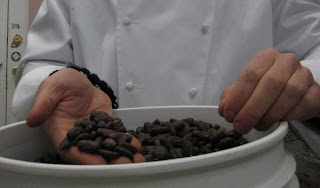
I also had the chance to sample some raw, unroasted cacaobeans (below) for the first time, they were from Jamaica. I found themmuch less bitter than I had anticipated, and with a sweetness I did notexpect still evidence of the sweet cacao pulp before some of its delicate flavor is roasted away. I really enjoyed it.
Colinoffered me a sample of the Ocumare, then the Sambirano, and he wasanxious to hear my response to his work, and kept pressing me for morefeedback than simply good. I told him that he would have to read therest on the blog. I told him I need to give this the full treatment,with the fresh palate in the morning, and he said la Chlo! Yesexactly, I replied, la Chlo!
Chlo is Chlo Doutre-Roussel ,whose name is inevitably encountered early on in the world of finechocolate. Her famous little pink book, the introductory manual Chocolate Connoisseur ,is familiar reading to most of fine chocolates initiated. More aboutChlo and her book later on the Chocolate Note. For now lets say sheis notorious for her six a.m. chocolate tastings, conducted with afresh palate no eating first!
Colintold me that he had just recently received an email from Chlo, whoheard about Rogue from the City Pages article, and is already on thescene offering guidance, asking questions, without even having tastedRogue chocolate. She has been encouraging him to stop using vanilla,which many in the new artisan movement are tending to omit. Colin doesnot use soy lecithin, also becoming more common practice among artisanmakers, and he uses nondeoderized cocoa butter. He would like to takeChlos advice and experiment with no vanilla, and also with no addedcocoa butter down the road. He would like to play with otherpercentages, but at this time his plans are to unveil the Jamaica,Trinidad, and Dominican Republic as 70% bars, sometime later this year.He is also working on a blend using some of the above origins plusArriba, and this will likely be a limited edition run.
Colinlooks forward to these and other experiments and admits he has a lot tolearn, and that his palate is still developing. When asked if he wouldhave a presence on the chocolate salon circuit next fall, he said hemay not be ready. He really wants the chocolate to be as close toperfectly where he wants it to be as possible, even if he thinks it isnot too far off now. For the time being he is content to work withsolid bars no flavored bars, no milk chocolate, no bonbons. He is happy to explainthat since he only processes cacao, sugar, and vanilla in his workshop,his products are currently 100% vegan, gluten, nut, and dairy sensitivefriendly!
And what chocolate bars other than his own is he happyto eat? I like the Theo Ghana, thats a good one for that nice cocoa-ykick. And I liked Scharffen Bergers last Cuyagua, once it settled alittle bit, for a couple months. And he can't say enough good thingsabout Steve DeVries and his chocolate. Steve has served as a source of inspiration and guidance to many of the newer artisan chocolate makers.
Andso, as promised, I have conducted my morning tastings and present myconclusions below. Colin himself is not so into these rituals aroundtasting times of day, palate cleansing, special methods No, he says I just put it in my mouth and chew. For his first twoefforts, I will say Bravissimo! As to the new chocolate, I look forwardto having new Rogue chocolate to put into my mouth and chew!
Wherecan you get Rogue chocolate? Outside of a few Twin Cities retaillocations, currently limited to the Kitchen Window, Surdyk's andKopplin's Coffee, it is currently only available through Rogue Chocolatier. And once you've ordered online the rest is simple, you know what to do put it in your mouth and chew!
 Ocumare
origin: Venezuela (Ocumare Valley)
rating: 9.2
An Ocumare to get your motor running. The champagne explosion is balanced by an appropriate amount of coffee and bitter notes.
Don'tlet the fact that my flavor notes are the shortest fool you, the tasteis is the most amazing part. The finish has an aromatic herb bouquetthat is best described as sprucey. More often than with any otherchocolate I have so far tasted, I had the feeling that there weredistinct flavors and aromas which I should be able to recognize, butwas not able to quite name. "What's that, oh, wait, what's that?"
aroma:raisin, currant, mint, olive, tobacco, banana, coffee, blackberry,walnut, cranberry, must, soy/tofu, bee pollen, blueberry, raspberry,leather, palm tree
flavor: chocolate, coffee, plum, cranberry, nutmeg, banana, bouquet of fruity wine/ champagne, bouquet of tropical fruits
finish: cream, coffee, dirt, hay, tobacco, mint, plum, water chestnut, hibiscus, doughnuts, bouquetof fruity wine, silk, mushroom, honey, bouquet of aromatic herbs: sage,lavender, and spruce, resin, lemon, cinnamon, apricot, flax seed,smoked fish, dandelion wine, orange, tomato, strawberry
Samibrano
origin: Madagascar (Sambirano Valley)
rating: 9.1
Forthe aftertaste, at first I thought, "This finish is not so stellar asthe aroma and taste had led me to expect," but every time Ithought,"Okay, that's it," it kept coming back, if subtly, with wavesof the most pleasant chocolate, overlapped at turns by nectar,marshmallow, craisin, and rose. So that by the time it really was done, my taste buds, like a child just finished with a ride at the fair, said "Let's go back and do it again!"
aroma:leather, cherry, walnut, almond, champagne, banana, blueberry,chocolate, dirt, coffee, caramel, nutmeg, cinnamon, floral
flavor:coconut, banana, chocolate, rose, blueberry, strawberry, raspberry,wine, bilberry, peppermint, hay, lime, plum, caramel, mint, mango
finish:blueberry spritzer, zinfandel, old leather boots, shoebox, lemon, lime,mango, white wine, Chardonnay, lime jello, cigar, toffee, plum, coffee,green apple jolly rancher candy, clove, lavender
View original post
A bean to bar chocolate manufacturer means a maker who does everything from the raw bean, starting with cacao beans that have been fermentedand dried by the grower, but not yet roasted. So the beans are takenall the way from this raw state to a molded bar of chocolate by thesame maker. The process begins with sorting, then roasting, thenwinnowing and cracking, then grinding, then mixing, then conching. Andthen there is tempering, molding, cooling, and wrapping. Colin does nothave employees, and much of this is his one man show. He is helped outby his father four days a week, and a friend pitches in ten hours aweek. Colin often relies on friends for transportation.

Therearent many bean to bar makers in the world, some 50 or so at lastverified count. About 20 are in the United States. When I say verified,it is because bean to bar has become a desirable label denoting anartisan maker, and so many chocolate companies seek to elevate theirstatus by claiming to make their chocolate bean to bar, but they are what else fudging the truth!
Sowithout a car, Colin gets rides, takes the bus, or rides his bike tohis Southeast Minneapolis warehouse space each day, which happens to beright next door to nationally known Twin Cities chocolatier B.T.McElrath, and there he usually spends 14 hour days perfecting hischocolate.
This manufacturing operation is all in one openspace, with one small storage alcove in the back, where Colin storeshis beans in 5 gallon plastic pails there is no room for large sacks of beans. As we progress along thetour, he says things like I use this as my cooling room, as he makesa sweeping motion to the wall in another part of the space, just acouple feet away from the conching room we are standing in, which isthe middle of the room. This funky metal rack is the room where thebars cool inside their molds resting on shelves. There are maybe 50bars in the cooling room today. And some 100 more against another wallawait their packaging in their very own wrapping room.
Much of the equipment has been custom built to a scale fitting the digs. The batch size at the time of my tour is small 30 lbs. A new conche is being built and is slated to arrive next month, and this will increase batch capacity to 200 lbs.
Colinprefers a shorter conching period of about 18 hours. He conches toabout 20 microns. The chocolate is currently aged one month. He prefersto age for two months, and says this will become possible when thebatch size increases with the new conche. With increasing demand due toa recent article in the local weekly City Pages, and such small batches, it has been difficult to let the chocolate sit a full two months as of yet.
Thefirst time Colin got the idea to go into business as a chocolate makerwas one year ago, only six months after the first time he had made hisown chocolate at home. He had been making truffles for awhile and foundthat to be limiting and an already crowded field, and so decided toembark on a little home made experiment, and his first bars were madeusing equipment from Chocolate Alchemy , aone stop shop for the home chocolate maker and the same way others havegotten their start. Like many other small batch artisan makers, Colinis teaching himself the trade by reading old manuals, consulting withother artisan makers, and by the experience of trial and error.
Colinhas eaten a lot of chocolate since he was a boy. When the tides ofchocolate making in this country began to gently turn toward a moreartisan approach, he took notice and became an early fan of ScharffenBerger when their first bars came out in the early 2000s.
CurrentlyRogue offers a Sambirano and an Ocumare, both at 70%. The next originson the docket are Trinidad, Dominican Republic, and Jamaica. I had achance to sample the Trinidad, Im a big fan of this origin, andcommented to Colin that what I liked best about his take on thisinteresting bean was the way he handled the coconut, differently thanTrinidad bars Ive had by other makers (namely Pralus and Amadei.) Andwith a smile he proudly told me that it was a trick he had pulled tobalance the coconut and fruit, and this was the reaction he was goingfor.
I also had the chance to sample some raw, unroasted cacaobeans (below) for the first time, they were from Jamaica. I found themmuch less bitter than I had anticipated, and with a sweetness I did notexpect still evidence of the sweet cacao pulp before some of its delicate flavor is roasted away. I really enjoyed it.

Colinoffered me a sample of the Ocumare, then the Sambirano, and he wasanxious to hear my response to his work, and kept pressing me for morefeedback than simply good. I told him that he would have to read therest on the blog. I told him I need to give this the full treatment,with the fresh palate in the morning, and he said la Chlo! Yesexactly, I replied, la Chlo!
Chlo is Chlo Doutre-Roussel ,whose name is inevitably encountered early on in the world of finechocolate. Her famous little pink book, the introductory manual Chocolate Connoisseur ,is familiar reading to most of fine chocolates initiated. More aboutChlo and her book later on the Chocolate Note. For now lets say sheis notorious for her six a.m. chocolate tastings, conducted with afresh palate no eating first!
Colintold me that he had just recently received an email from Chlo, whoheard about Rogue from the City Pages article, and is already on thescene offering guidance, asking questions, without even having tastedRogue chocolate. She has been encouraging him to stop using vanilla,which many in the new artisan movement are tending to omit. Colin doesnot use soy lecithin, also becoming more common practice among artisanmakers, and he uses nondeoderized cocoa butter. He would like to takeChlos advice and experiment with no vanilla, and also with no addedcocoa butter down the road. He would like to play with otherpercentages, but at this time his plans are to unveil the Jamaica,Trinidad, and Dominican Republic as 70% bars, sometime later this year.He is also working on a blend using some of the above origins plusArriba, and this will likely be a limited edition run.
Colinlooks forward to these and other experiments and admits he has a lot tolearn, and that his palate is still developing. When asked if he wouldhave a presence on the chocolate salon circuit next fall, he said hemay not be ready. He really wants the chocolate to be as close toperfectly where he wants it to be as possible, even if he thinks it isnot too far off now. For the time being he is content to work withsolid bars no flavored bars, no milk chocolate, no bonbons. He is happy to explainthat since he only processes cacao, sugar, and vanilla in his workshop,his products are currently 100% vegan, gluten, nut, and dairy sensitivefriendly!
And what chocolate bars other than his own is he happyto eat? I like the Theo Ghana, thats a good one for that nice cocoa-ykick. And I liked Scharffen Bergers last Cuyagua, once it settled alittle bit, for a couple months. And he can't say enough good thingsabout Steve DeVries and his chocolate. Steve has served as a source of inspiration and guidance to many of the newer artisan chocolate makers.
Andso, as promised, I have conducted my morning tastings and present myconclusions below. Colin himself is not so into these rituals aroundtasting times of day, palate cleansing, special methods No, he says I just put it in my mouth and chew. For his first twoefforts, I will say Bravissimo! As to the new chocolate, I look forwardto having new Rogue chocolate to put into my mouth and chew!
Wherecan you get Rogue chocolate? Outside of a few Twin Cities retaillocations, currently limited to the Kitchen Window, Surdyk's andKopplin's Coffee, it is currently only available through Rogue Chocolatier. And once you've ordered online the rest is simple, you know what to do put it in your mouth and chew!
 Ocumare
origin: Venezuela (Ocumare Valley)
rating: 9.2
An Ocumare to get your motor running. The champagne explosion is balanced by an appropriate amount of coffee and bitter notes.
Don'tlet the fact that my flavor notes are the shortest fool you, the tasteis is the most amazing part. The finish has an aromatic herb bouquetthat is best described as sprucey. More often than with any otherchocolate I have so far tasted, I had the feeling that there weredistinct flavors and aromas which I should be able to recognize, butwas not able to quite name. "What's that, oh, wait, what's that?"
aroma:raisin, currant, mint, olive, tobacco, banana, coffee, blackberry,walnut, cranberry, must, soy/tofu, bee pollen, blueberry, raspberry,leather, palm tree
flavor: chocolate, coffee, plum, cranberry, nutmeg, banana, bouquet of fruity wine/ champagne, bouquet of tropical fruits
finish: cream, coffee, dirt, hay, tobacco, mint, plum, water chestnut, hibiscus, doughnuts, bouquetof fruity wine, silk, mushroom, honey, bouquet of aromatic herbs: sage,lavender, and spruce, resin, lemon, cinnamon, apricot, flax seed,smoked fish, dandelion wine, orange, tomato, strawberry
Samibrano
origin: Madagascar (Sambirano Valley)
rating: 9.1
Forthe aftertaste, at first I thought, "This finish is not so stellar asthe aroma and taste had led me to expect," but every time Ithought,"Okay, that's it," it kept coming back, if subtly, with wavesof the most pleasant chocolate, overlapped at turns by nectar,marshmallow, craisin, and rose. So that by the time it really was done, my taste buds, like a child just finished with a ride at the fair, said "Let's go back and do it again!"
aroma:leather, cherry, walnut, almond, champagne, banana, blueberry,chocolate, dirt, coffee, caramel, nutmeg, cinnamon, floral
flavor:coconut, banana, chocolate, rose, blueberry, strawberry, raspberry,wine, bilberry, peppermint, hay, lime, plum, caramel, mint, mango
finish:blueberry spritzer, zinfandel, old leather boots, shoebox, lemon, lime,mango, white wine, Chardonnay, lime jello, cigar, toffee, plum, coffee,green apple jolly rancher candy, clove, lavender
View original post
Posted in: default
| 7 comments
When it comes to learning about the history of chocolate, most people never look past the excellent book, The True History of Chocolate by Sophie and Michael Coe. I have to say that the timing of the publishing of this book (1996) was instrumental in my quest to become a chocolate critic. While I am sure that the Coe's did a fair amount of primary research, much of what they wrote was gleaned from the writings of others, which can be confirmed by taking a look at the bibliography.
Many of the sources that are referenced are not easily accessible - even in the current age of Internet access - unless you have access to a good university research library.
For me, one of the cool things about chocolate is that it affords me an opportunity to satisfy my curiosity on a lot of subjects. While I do the tasting and criticism things, my ability to do these is informed by my knowledge of the history, cultural anthropology, economics, agronomy, genetics, and more about chocolate. Chocolate is a lens that I use to look at any subject of interest.
So, if it's not easy to get access to many of these resources, where can you go to learn more?
One great resource is Project Gutenberg, a collection of eBooks that are in the public domain. I like to use the resources at archive.org because they aggregate the Project Gutenberg eBooks with those available from other sources.
One eBook I can recommend is The Project Gutenberg EBook of Cocoa and Chocolate, by Arthur W. Knapp, originally published in 1920 and titled Cocoa and Chocolate: Their History from Plantation to Consumer.
Click here to read the eBook online in a web browser.
The text is also available for download in a few different formats from links on this page:
From time to time I will be posting other good learning resources that are available online as comments to this post. (Book recommendations will be posted in the forums in the Book Reviews category.) If you have some online resources that you'd like to recommend, you can post them here.
Many of the sources that are referenced are not easily accessible - even in the current age of Internet access - unless you have access to a good university research library.
For me, one of the cool things about chocolate is that it affords me an opportunity to satisfy my curiosity on a lot of subjects. While I do the tasting and criticism things, my ability to do these is informed by my knowledge of the history, cultural anthropology, economics, agronomy, genetics, and more about chocolate. Chocolate is a lens that I use to look at any subject of interest.
So, if it's not easy to get access to many of these resources, where can you go to learn more?
One great resource is Project Gutenberg, a collection of eBooks that are in the public domain. I like to use the resources at archive.org because they aggregate the Project Gutenberg eBooks with those available from other sources.
One eBook I can recommend is The Project Gutenberg EBook of Cocoa and Chocolate, by Arthur W. Knapp, originally published in 1920 and titled Cocoa and Chocolate: Their History from Plantation to Consumer.
Click here to read the eBook online in a web browser.
The text is also available for download in a few different formats from links on this page:
From time to time I will be posting other good learning resources that are available online as comments to this post. (Book recommendations will be posted in the forums in the Book Reviews category.) If you have some online resources that you'd like to recommend, you can post them here.
Posted in: default
| 0 comments
If you scroll down the home page of The Chocolate Life you'll see a new calendar of events I have created. If you have (or know of) an event that can be included on this calendar, send me a message and I will add it. Better yet, please leave your recommendations as comments to this post.
Posted in: default
| 8 comments
Do biotic community dynamics of shaded coffee plantations inform cacao plantations?
By Lorna, 2008-01-29
I went to a talk last week about the dynamics of biotic communities on coffee plants on a 100 year-old organic shaded coffee plantation. The biotic interactions were fascinating, and ever increasing as the speaker elaborated on her research. The speaker was Ivette Perfecto from the University of Michigan. Here's the gist:
Arboreal ants live in nests in the shade trees and come down to tend scales (coffee herbivores) on the coffee plants and eat the honeydew produced by the scales. At first glance, it's boo ants.
The ants are parasitized by a decapitating fly that kills ant nests, leaving aggregates of the arboreal ant nests rather than a dense blanket of nests across the plantation. So the ant parasites hedge ant populations and thereby the scale populations too.
An adult beetle is a coffee herbivore and is predated upon by the arboreal ants. So, in the presence of the adult beetles, a good level of ants is beneficial. Yay ants. However, young beetle larvae are covered in fuzz that fumbles up ant mandibles, allowing beetle larvae to live in refuges near the ants' scale farms. Thus, ants are both helping and hindering beetle populations.
Additionally, coffee beetle borers dive into the fruit and eat the seed. Ants camp out by the bored hole to predate on them. Yay for ants again.
Finally, coffee rust (a leaf fungus) is present in Central America but has not started to threaten a crop collapse (as it did in Sri Lanka, which now grows tea). This is seriously scary stuff. A different white ring fungus grows on the tended scales and harms the coffee plants and is possibly transmitted by the tending ants. So it's boo for ants and scales again, except that the presence of this white fungus appears to stymy the growth of the more dangerous coffee rust. So, it's actually yay for ants again.
Surely this story only gets larger. As with any ecosystem, boundaries are fuzzy and dynamics are like ripples. However, it is a complete enough story to see that the shade trees harbor a rather useful biotic control, namely the ants. Farmers are disposed to see them tending harmful scales and dislike them. Educational efforts are being made to communicate the benefit of this intertwined system that acts like a rubber band web, pulling the system back to stability after perturbations. And especially the resilience it offers to the greatest perturbation: the threat of collapse from coffee rust.
Natural systems are unique in that their complexity creates an effective buffer against disturbance. (One striking note is that this plantation has acquired such a complex biotic system in only a century.) A shaded plantation is by definition more complex in its flora. Cacao, a shade crop, might also reveal such dynamism in both plantations and natural forests.
When I asked the speaker, she said that cacao research lags coffee research, but has begun in earnest in the last 5 years or so. I will definitely keep an ear to the field and report back!
Arboreal ants live in nests in the shade trees and come down to tend scales (coffee herbivores) on the coffee plants and eat the honeydew produced by the scales. At first glance, it's boo ants.
The ants are parasitized by a decapitating fly that kills ant nests, leaving aggregates of the arboreal ant nests rather than a dense blanket of nests across the plantation. So the ant parasites hedge ant populations and thereby the scale populations too.
An adult beetle is a coffee herbivore and is predated upon by the arboreal ants. So, in the presence of the adult beetles, a good level of ants is beneficial. Yay ants. However, young beetle larvae are covered in fuzz that fumbles up ant mandibles, allowing beetle larvae to live in refuges near the ants' scale farms. Thus, ants are both helping and hindering beetle populations.
Additionally, coffee beetle borers dive into the fruit and eat the seed. Ants camp out by the bored hole to predate on them. Yay for ants again.
Finally, coffee rust (a leaf fungus) is present in Central America but has not started to threaten a crop collapse (as it did in Sri Lanka, which now grows tea). This is seriously scary stuff. A different white ring fungus grows on the tended scales and harms the coffee plants and is possibly transmitted by the tending ants. So it's boo for ants and scales again, except that the presence of this white fungus appears to stymy the growth of the more dangerous coffee rust. So, it's actually yay for ants again.
Surely this story only gets larger. As with any ecosystem, boundaries are fuzzy and dynamics are like ripples. However, it is a complete enough story to see that the shade trees harbor a rather useful biotic control, namely the ants. Farmers are disposed to see them tending harmful scales and dislike them. Educational efforts are being made to communicate the benefit of this intertwined system that acts like a rubber band web, pulling the system back to stability after perturbations. And especially the resilience it offers to the greatest perturbation: the threat of collapse from coffee rust.
Natural systems are unique in that their complexity creates an effective buffer against disturbance. (One striking note is that this plantation has acquired such a complex biotic system in only a century.) A shaded plantation is by definition more complex in its flora. Cacao, a shade crop, might also reveal such dynamism in both plantations and natural forests.
When I asked the speaker, she said that cacao research lags coffee research, but has begun in earnest in the last 5 years or so. I will definitely keep an ear to the field and report back!
Posted in: default
| 0 comments
According to their monthly newsletter, Costco says that Theo is making a "limited" (as limited as anything that is sold in Costco can be) edition Valentine's Gift Set.
This follows a trend for well-known chocolate companies to sell their wares through Costco. While probably less destructive to the bottom line than selling through WalMart, the fact that people can purchase the chocolate at 20% normal retail prices would indicate that Theo is not making its customary margins.
The Gift Set is actually pretty extensive and would make a decent introduction to their products for an emerging chocophile: 5 origin bars, 6 flavored bars, and 6 bob bons. The article does not give a price, you'll either have to go online or into your local Costco to find that out.
This follows a trend for well-known chocolate companies to sell their wares through Costco. While probably less destructive to the bottom line than selling through WalMart, the fact that people can purchase the chocolate at 20% normal retail prices would indicate that Theo is not making its customary margins.
The Gift Set is actually pretty extensive and would make a decent introduction to their products for an emerging chocophile: 5 origin bars, 6 flavored bars, and 6 bob bons. The article does not give a price, you'll either have to go online or into your local Costco to find that out.
Posted in: default
| 3 comments
Hold on to your hats everyone, rumor has it that Starbucks will be getting into the "artisan" chocolate business in a big way pretty soon. Given the number of doors (that's the technical term that people use when they talk about the number of stores) in the Starbucks franchise it stretches credulity to believe that the chocolate will actually be made using artisan production methods. When I know more I will let everyone know what I find out.
In the meantime, take a moment to post your thoughts in the Forum Discussion "What Makes an Artisan Chocolate Artisan?"
In the meantime, take a moment to post your thoughts in the Forum Discussion "What Makes an Artisan Chocolate Artisan?"
Posted in: default
| 6 comments
The majority of the growth in the premium chocolate business in the US over the past several years has come as a result of an increase in interest in artisan confections. This has led to dramatic growth in the number of artisan chocolatiers capable of commanding premium prices for their goods.
Less dramatic, but no less interesting, has been the growth of artisan chocolate makers in the US. In 2005 the list contained one name: Scharffen Berger Chocolate Maker.
Their success, however, encouraged a number of people to start seriously looking at getting into the business of making artisan chocolate. The purchase of Scharffen Berger by Hershey Artisan Confections validated their efforts as it signaled that there were possible exit strategies beyond passing the business on to family members.
2006 and 2007 have seen the introduction of a new generation of artisan (defined as batch processed as opposed to continuous processing) chocolate makers. Interestingly, they are all in the West and Midwest: Theo in Seattle, Amano in Utah, DeVries in Colorado, and Askinosie and Patric in Missouri. While all are still learning their craft, each of them approaches the art of making chocolate with entirely different purposes and different equipment. Where they may be most alike is in the way they were started and financed: They are the product of individual visions, they have all taken two or more years from concept to production, and they are all closely-held.
The new kid on the block, TCHO in San Francisco, is about to change much of that.
The brainchild of Timothy Childs, a co-founder of Cabaret Chocolates who used to work on space shuttles before he started making chocolates. After a disagreement about the direction of the company that led to his leaving Cabaret, Timothy started looking closely at getting into making chocolate rather than confections. That interest was driven, in part, by his original desire to limit Cabaret's reliance on chocolate from a single manufacturer located in Venezuela. Although the chocolate might have been good, the political situation in Venezuela is unstable, to put it mildly. Timothy was encouraged along this path by one of the investors in Cabaret as well as a long-time friend, Louis Rossetto, who is probably best known as a co-founder of Wired magazine.
From the start, one of the more interesting aspects of TCHO's development was the mashup of traditional chocolate-making technology and Silicon Valley-inspired innovation and entrepreneurialism. It was not just enough to buy old machinery and refurbish it, TCHO hired a master mechanic and roboticist to strip away all of the old electrics and replace them with state-of-the-art process control electronics. The old equipment links them to traditional methods of artisan chocolate making that is enhanced by an awareness of what is happening at every stage of the process - and the ability to control many of the variables - normally only available to industrial processors.
This blend of art and tech inspired by the lessons of Silicon Valley permeates everything TCHO does. It's not just enough to make chocolate, they have to look at chocolate making technology and see how and where it might be improved. It's not just enough to make chocolate, they have to re-think the way chocolate is being marketed and sold. Does percentage cacao really mean anything? What about origin? What about organic and "Fair Trade?" And (while they're at it), why not think about the vocabulary of chocolate and see if there is a way to make it easier for people to understand?
This questioning of commonly-held assumptions is an integral part of many Silicon Valley startups. But it's definitely unusual for the chocolate industry.
An example of just how different TCHO is going to be was revealed late last year when their first production was made available as a public "beta test." A large chocolate company would have held focus groups and done limited distribution in test markets to figure out consumer reaction to their product - a process that can cost hundreds of thousands if not millions of dollars. Most artisan chocolate makers avoid any sort of market testing. They trust their instincts and the opinions of a few close friends.
TCHO, on the other hand, published an invitation on their web site for people who wanted to be involved in the development process. This is common in software and Internet development but highly unusual for food products.
Not only did TCHO save a bundle but they were able to build an enormous amount of word of mouth at quite a low cost, leveraging their knowledge of the Internet by applying it in a food marketing context.
TCHO is also looking at ways to simplify the chocolate-buying experience by avoiding the chocolate marketing trend that is most in vogue this season, percentage, and placing lesser importance on origin. The designation of the current beta release bar is "Beta C Ghana 0.XX." The 'Beta' designation means that the bar is still being tested, the 'C' stands for the flavor profile (chocolatey - as opposed to fruity, nutty, etc.), and the '0.XX' is the 'version number' of the release. Ghana is the country of origin of the beans, and as the web site attests, "refers to the single source for our 'chocolatey' bar, a land known for deep, rich cacao." TCHO runs a small test lab and can turn around new versions of a chocolate based on feedback from beta testers in as little as 36 hours.
In talking with Timothy about their naming process - finding ways to accurately and succinctly talk about chocolate has occupied a lot of my time over the past decade - one unanticipated side-effect of the decision to simplify the naming scheme arose. That is that TCHO's choices for beans are much more tightly constrained than they would be if they were promoting origin and percentage. What Timothy (who does most of the bean sourcing) has to do is find beans that, when processed and made into chocolate, will deliver the particular flavor profile they are looking for. Usually, when making origin chocolate, the chocolate maker tries to express the varietal and terroir characteristics of the beans - whatever that happens to be.
To do that, TCHO is working very closely with the farmers from whom they purchase their beans in a program that TCHO calls "Smart Sourcing." Where I can appreciate the technical and market innovation TCHO is committed to, in the end, it is probably their approach to bean sourcing that will have the most profound and lasting impact on the chocolate industry.
The best parallel that can be made is the application of technology to the California wine industry. Prior to the development of the wine industry in California, high-end wine making was pretty much an art form based on hard-earned knowledge passed down as oral tradition through apprenticeships from previous generations. What really kick-started California's growth as a major wine producer was the use of technology to deconstruct how great French wines were made and then to develop methods for understanding - and ultimately controlling - every aspect of the wine-making process.
By comparison and in the most fundamental and important ways, cacao post-harvest processing remains in the stone age. For example, very little is actually known about what variables affect fermentation and drying, and farmers, who are mostly responsible for doing the fermentation and drying, do not have access to accurate thermometers, moisture meters, and pH meters. While $300 for a moisture meter may not seem like a lot to you or me, in many cacao-growing countries it can represent the entire value of the cacao crop for a farmer for a year and so is simply beyond reach. For a chocolate company looking to source quality beans, the investment is trivial compared with the potential return.
But can't co-ops afford technology like this? In many cases, yes, but often they lack the sophistication and the will to make these sorts of community investments, even though everyone would clearly benefit. One of the best examples of this I personally came across was in a loosely-knit community of 90 farm families in Barlovento, a region in Venezuela known for its cacao (the Hacienda Concepcion, made famous by Cluizel, is in Barlovento). Even though the community had been organized for a decade, as a group they had never been able to agree to pool their profits to build a community fermentation center and drying pad even though doing so would be an invaluable resource to the community on many different levels, not least of which would be improving the consistency and quality of the cocoa they produced. As a group they lacked the will to do this and if even one farmer declined to contribute, the rest would not go ahead without that family's involvement.
Unfortunately, this is all-too-common behavior in many cacao-growing countries. (Come to think about it, it's all too common here in the US, where entrenched self-interest often trumps community investment.)
Eventually, Timothy envisions a mesh of sensors that evaluate and record every aspect of what's going on in and around a fermentation box, correlating (for example) changes in ambient temperature and humidity with changes in chemical and thermal activity in the heap of fermenting beans. By doing so they hope to be able to develop reliable guides for optimal fermentation and drying, by varietal, by country. Better fermentation means better cocoa, which also means better chocolate. More importantly, by focusing on product quality issues, TCHO fully expects the farmers to start charging them more for beans, creating what is called a "virtuous cycle" (in TCHO-speak, a 'spiral of quality'). Investing in farmers to improve quality results in an increase in bean quality that results in the farmer being able to earn more for their labor which results in improving the quality of life for the farmer and his family which will lead to continued improvement in the quality of the beans because the farmer gets a tangible - and meaningful - return on his investment of labor.
In typical TCHO style, Timothy is committed to innovating the cocoa supply chain into a "supply loop." TCHO plans to take a percentage of revenues and reinvest them in hard tangible improvements in the cocoa processing facilities of their farmers. They also plan to invest early, before seeing finished crops, working with any person or entity that is interested to develop low-cost fermentation, drying, and other equipment and techniques and then transferring what they have learned to the farmer.
But how is the chocolate? It's still in Beta so it's really too early to tell. I was fortunate enough to get my hands on a couple of bars from two earlier beta releases, and while there was definitely room for improvement, the initial results indicate that when they finally settle on a recipe they'll have achieved something remarkable from bulk West African amelonado Forastero beans.
Here are my initial impressions that I made on the TCHO chocolate bars I beta-tested. (I can't believe I just wrote that.) In this e-mail I sent to Timothy, I am using for the first time some new language of my own to describe the flavor profile of a chocolate based on a music analogy in an attempt to reduce reliance on terminology borrowed from the wine world. (I'd like to hear your thoughts on this analogy - pleae comment.)
When I think of chocolatey when it comes to chocolate, one of the common flavor profiles that comes to mind is "baked brownie" and both the 0.18a and 0.18b batches have traces of this flavor in them.
Where the two batches differ most is in the "attack/decay/sustain/release" profile of the fruit acid flavors. In the 0.18a batch the fruit acids come to the front more quickly and are "sharper" (the attack) than in the 0.18b batch. The fruit acid notes - which don't really have a distinctive flavor although they are probably more red fruit without any "drying" flavors (astringency) in them - diminish more slowly (the decay) and stay around slightly longer (the sustain).
Both batches have lightweight but quite long "releases" (or more commonly, finishes) to them in which the baked brownie flavor predominates but is joined by some other flavors. I detect virtually no astringency in either sample, which is pretty remarkable for typical Ghanaian beans - amelonado Forastero genetics feature quite heavily here. This lack of astringency from tannins and accompanying bitterness suggests that you are getting better than average fermentation delivered by most Ghanaian farmers. Careful roasting prevents the formation of bitter and tannic compounds from the flavor precursor components that are the result of fermentation and drying.
The very long aftertaste on both is very clean which is a strong sign of good quality control all the way through the process.
The relatively complex nature of the flavor profile is interesting for a chocolate using beans of West African origin. Normally I find the flavors of West African chocolate more monotonic, so being able to balance the fruit acid with the chocolatey flavors is something of an accomplishment.
The TCHO beta has now been opened up and they are accepting orders from all over the country and shipping them. For more information and to order, visit www.TCHO.com.
Less dramatic, but no less interesting, has been the growth of artisan chocolate makers in the US. In 2005 the list contained one name: Scharffen Berger Chocolate Maker.
Their success, however, encouraged a number of people to start seriously looking at getting into the business of making artisan chocolate. The purchase of Scharffen Berger by Hershey Artisan Confections validated their efforts as it signaled that there were possible exit strategies beyond passing the business on to family members.
2006 and 2007 have seen the introduction of a new generation of artisan (defined as batch processed as opposed to continuous processing) chocolate makers. Interestingly, they are all in the West and Midwest: Theo in Seattle, Amano in Utah, DeVries in Colorado, and Askinosie and Patric in Missouri. While all are still learning their craft, each of them approaches the art of making chocolate with entirely different purposes and different equipment. Where they may be most alike is in the way they were started and financed: They are the product of individual visions, they have all taken two or more years from concept to production, and they are all closely-held.
The new kid on the block, TCHO in San Francisco, is about to change much of that.
The brainchild of Timothy Childs, a co-founder of Cabaret Chocolates who used to work on space shuttles before he started making chocolates. After a disagreement about the direction of the company that led to his leaving Cabaret, Timothy started looking closely at getting into making chocolate rather than confections. That interest was driven, in part, by his original desire to limit Cabaret's reliance on chocolate from a single manufacturer located in Venezuela. Although the chocolate might have been good, the political situation in Venezuela is unstable, to put it mildly. Timothy was encouraged along this path by one of the investors in Cabaret as well as a long-time friend, Louis Rossetto, who is probably best known as a co-founder of Wired magazine.
From the start, one of the more interesting aspects of TCHO's development was the mashup of traditional chocolate-making technology and Silicon Valley-inspired innovation and entrepreneurialism. It was not just enough to buy old machinery and refurbish it, TCHO hired a master mechanic and roboticist to strip away all of the old electrics and replace them with state-of-the-art process control electronics. The old equipment links them to traditional methods of artisan chocolate making that is enhanced by an awareness of what is happening at every stage of the process - and the ability to control many of the variables - normally only available to industrial processors.
This blend of art and tech inspired by the lessons of Silicon Valley permeates everything TCHO does. It's not just enough to make chocolate, they have to look at chocolate making technology and see how and where it might be improved. It's not just enough to make chocolate, they have to re-think the way chocolate is being marketed and sold. Does percentage cacao really mean anything? What about origin? What about organic and "Fair Trade?" And (while they're at it), why not think about the vocabulary of chocolate and see if there is a way to make it easier for people to understand?
This questioning of commonly-held assumptions is an integral part of many Silicon Valley startups. But it's definitely unusual for the chocolate industry.
An example of just how different TCHO is going to be was revealed late last year when their first production was made available as a public "beta test." A large chocolate company would have held focus groups and done limited distribution in test markets to figure out consumer reaction to their product - a process that can cost hundreds of thousands if not millions of dollars. Most artisan chocolate makers avoid any sort of market testing. They trust their instincts and the opinions of a few close friends.
TCHO, on the other hand, published an invitation on their web site for people who wanted to be involved in the development process. This is common in software and Internet development but highly unusual for food products.

Packaging of the TCHO beta bars.
Not only did TCHO save a bundle but they were able to build an enormous amount of word of mouth at quite a low cost, leveraging their knowledge of the Internet by applying it in a food marketing context.
TCHO is also looking at ways to simplify the chocolate-buying experience by avoiding the chocolate marketing trend that is most in vogue this season, percentage, and placing lesser importance on origin. The designation of the current beta release bar is "Beta C Ghana 0.XX." The 'Beta' designation means that the bar is still being tested, the 'C' stands for the flavor profile (chocolatey - as opposed to fruity, nutty, etc.), and the '0.XX' is the 'version number' of the release. Ghana is the country of origin of the beans, and as the web site attests, "refers to the single source for our 'chocolatey' bar, a land known for deep, rich cacao." TCHO runs a small test lab and can turn around new versions of a chocolate based on feedback from beta testers in as little as 36 hours.
In talking with Timothy about their naming process - finding ways to accurately and succinctly talk about chocolate has occupied a lot of my time over the past decade - one unanticipated side-effect of the decision to simplify the naming scheme arose. That is that TCHO's choices for beans are much more tightly constrained than they would be if they were promoting origin and percentage. What Timothy (who does most of the bean sourcing) has to do is find beans that, when processed and made into chocolate, will deliver the particular flavor profile they are looking for. Usually, when making origin chocolate, the chocolate maker tries to express the varietal and terroir characteristics of the beans - whatever that happens to be.
To do that, TCHO is working very closely with the farmers from whom they purchase their beans in a program that TCHO calls "Smart Sourcing." Where I can appreciate the technical and market innovation TCHO is committed to, in the end, it is probably their approach to bean sourcing that will have the most profound and lasting impact on the chocolate industry.
The best parallel that can be made is the application of technology to the California wine industry. Prior to the development of the wine industry in California, high-end wine making was pretty much an art form based on hard-earned knowledge passed down as oral tradition through apprenticeships from previous generations. What really kick-started California's growth as a major wine producer was the use of technology to deconstruct how great French wines were made and then to develop methods for understanding - and ultimately controlling - every aspect of the wine-making process.
By comparison and in the most fundamental and important ways, cacao post-harvest processing remains in the stone age. For example, very little is actually known about what variables affect fermentation and drying, and farmers, who are mostly responsible for doing the fermentation and drying, do not have access to accurate thermometers, moisture meters, and pH meters. While $300 for a moisture meter may not seem like a lot to you or me, in many cacao-growing countries it can represent the entire value of the cacao crop for a farmer for a year and so is simply beyond reach. For a chocolate company looking to source quality beans, the investment is trivial compared with the potential return.
But can't co-ops afford technology like this? In many cases, yes, but often they lack the sophistication and the will to make these sorts of community investments, even though everyone would clearly benefit. One of the best examples of this I personally came across was in a loosely-knit community of 90 farm families in Barlovento, a region in Venezuela known for its cacao (the Hacienda Concepcion, made famous by Cluizel, is in Barlovento). Even though the community had been organized for a decade, as a group they had never been able to agree to pool their profits to build a community fermentation center and drying pad even though doing so would be an invaluable resource to the community on many different levels, not least of which would be improving the consistency and quality of the cocoa they produced. As a group they lacked the will to do this and if even one farmer declined to contribute, the rest would not go ahead without that family's involvement.
Unfortunately, this is all-too-common behavior in many cacao-growing countries. (Come to think about it, it's all too common here in the US, where entrenched self-interest often trumps community investment.)
Eventually, Timothy envisions a mesh of sensors that evaluate and record every aspect of what's going on in and around a fermentation box, correlating (for example) changes in ambient temperature and humidity with changes in chemical and thermal activity in the heap of fermenting beans. By doing so they hope to be able to develop reliable guides for optimal fermentation and drying, by varietal, by country. Better fermentation means better cocoa, which also means better chocolate. More importantly, by focusing on product quality issues, TCHO fully expects the farmers to start charging them more for beans, creating what is called a "virtuous cycle" (in TCHO-speak, a 'spiral of quality'). Investing in farmers to improve quality results in an increase in bean quality that results in the farmer being able to earn more for their labor which results in improving the quality of life for the farmer and his family which will lead to continued improvement in the quality of the beans because the farmer gets a tangible - and meaningful - return on his investment of labor.
In typical TCHO style, Timothy is committed to innovating the cocoa supply chain into a "supply loop." TCHO plans to take a percentage of revenues and reinvest them in hard tangible improvements in the cocoa processing facilities of their farmers. They also plan to invest early, before seeing finished crops, working with any person or entity that is interested to develop low-cost fermentation, drying, and other equipment and techniques and then transferring what they have learned to the farmer.
But how is the chocolate? It's still in Beta so it's really too early to tell. I was fortunate enough to get my hands on a couple of bars from two earlier beta releases, and while there was definitely room for improvement, the initial results indicate that when they finally settle on a recipe they'll have achieved something remarkable from bulk West African amelonado Forastero beans.
Here are my initial impressions that I made on the TCHO chocolate bars I beta-tested. (I can't believe I just wrote that.) In this e-mail I sent to Timothy, I am using for the first time some new language of my own to describe the flavor profile of a chocolate based on a music analogy in an attempt to reduce reliance on terminology borrowed from the wine world. (I'd like to hear your thoughts on this analogy - pleae comment.)
When I think of chocolatey when it comes to chocolate, one of the common flavor profiles that comes to mind is "baked brownie" and both the 0.18a and 0.18b batches have traces of this flavor in them.
Where the two batches differ most is in the "attack/decay/sustain/release" profile of the fruit acid flavors. In the 0.18a batch the fruit acids come to the front more quickly and are "sharper" (the attack) than in the 0.18b batch. The fruit acid notes - which don't really have a distinctive flavor although they are probably more red fruit without any "drying" flavors (astringency) in them - diminish more slowly (the decay) and stay around slightly longer (the sustain).
Both batches have lightweight but quite long "releases" (or more commonly, finishes) to them in which the baked brownie flavor predominates but is joined by some other flavors. I detect virtually no astringency in either sample, which is pretty remarkable for typical Ghanaian beans - amelonado Forastero genetics feature quite heavily here. This lack of astringency from tannins and accompanying bitterness suggests that you are getting better than average fermentation delivered by most Ghanaian farmers. Careful roasting prevents the formation of bitter and tannic compounds from the flavor precursor components that are the result of fermentation and drying.
The very long aftertaste on both is very clean which is a strong sign of good quality control all the way through the process.
The relatively complex nature of the flavor profile is interesting for a chocolate using beans of West African origin. Normally I find the flavors of West African chocolate more monotonic, so being able to balance the fruit acid with the chocolatey flavors is something of an accomplishment.
The TCHO beta has now been opened up and they are accepting orders from all over the country and shipping them. For more information and to order, visit www.TCHO.com.
Posted in: default
| 2 comments